
.svg)
How to choose a building plot with development potential

Selecting and purchasing a plot of land with development potential isn't solely dependent on price, location, and area. Often, a seemingly good plot of land might not be suitable for construction at all due to legal, zoning, or technical restrictions.
Therefore, before purchasing a plot of land, it's crucial to conduct a comprehensive study of it—from legal, urban, engineering, and practical perspectives—to ensure that a plot is chosen on which construction can be successfully carried out, and obtaining a building permit.
Below, we will discuss the key factors that must be checked before purchasing a plot of land.
1. Checking the Public Registry extract
The study of the plot should begin with the Public Registry extract.
The extract should be checked for:
- Form of ownership;
- Owner or co-owners;
- Liabilities;
- Seizure;
- Mortgage;
- Servitude;
- Other legal restrictions.
A plot of land might not appear problematic visually, but there could be a restriction in the registry data that turns its purchase or subsequent development into a serious risk.
Land Purchase and Advice - Tamar Kerdzaia, Otar Narchelashvili; Good Morning Georgia:
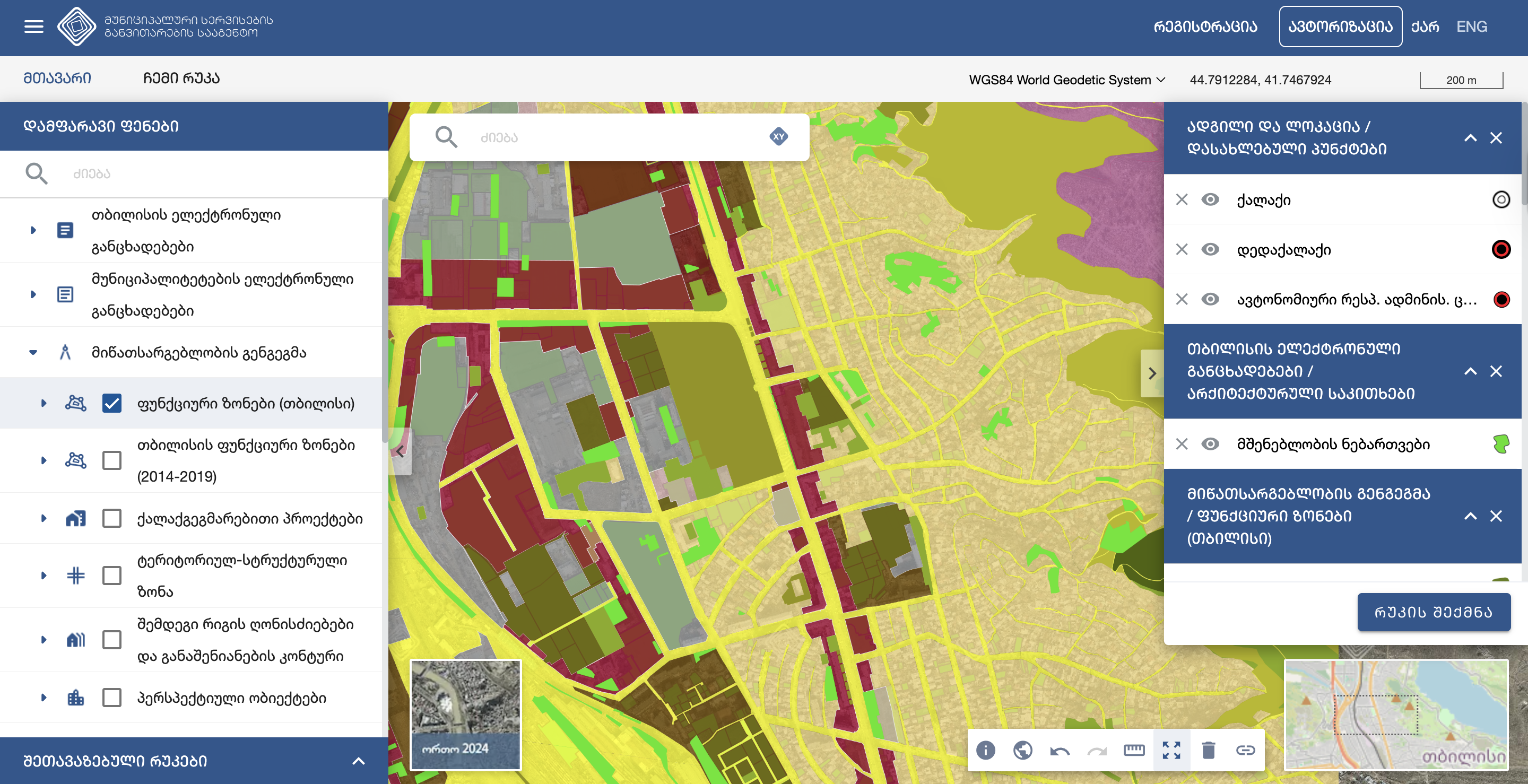
2. Which zone the plot of land is located in
The development of every plot of land is regulated by construction legislation and zoning.
The zone determines what type of building can be constructed on a specific plot of land, or if construction is possible at all.
For example:
Residential zone — primarily intended for the construction of residential buildings.
Commercial and Business Zone — allows for the development of commercial, office, public, and similar purpose facilities.
Industrial Zone — intended for manufacturing and industrial facilities.
Forestry and Landscape Zones — construction in such zones is typically prohibited or strictly limited. Consequently, plots of this nature are often unsuitable for construction development.
Therefore, before purchasing a plot of land, it is crucial to first determine its zoning classification and whether that zone aligns with the buyer's objectives.
3. Registered Plot Area
Building zones and applicable development regulations also determine the minimum plot area.
This means that construction is not automatically permitted on every plot, simply because it is land.
In many cases, the minimum plot area must be at least 200 square meters. If a plot does not meet this requirement, construction may be prohibited, or additional restrictions may apply.
Therefore, it is essential to verify not only the actual area but also the area registered in the public registry.
4. Assessment of Building Coefficients — K1, K2, K3
The building zone also determines the key development coefficients: K1, K2, and K3.
These coefficients directly determine the scale of construction that can be undertaken on a specific plot of land.
Specifically:
K1 Determines what portion of the land a building's footprint can occupy, i.e., the maximum square footage for the ground floor's developed area.
K2 It determines the total construction area of the building and practically answers the question — what volume of building can be constructed.
K3 It determines what portion of the land should be allocated for landscaping.
Without evaluating the coefficients, it's impossible to accurately determine:
- how many square meters of building we can construct;
- on how many floors the object can be developed;
- what height the building can be;
- what portion of the land must remain for landscaping;
- how well the plot aligns with our investment or residential goals.
Accordingly, the analysis of coefficients is one of the main stages in land plot evaluation.
5. Official Access Road
A land plot must necessarily have an officially, legally registered access road.
A de facto road alone is not sufficient.
In practice, cases often arise where physical access to the plot is possible, but the road is not legally registered. In such cases, obtaining a construction permit may become impossible.
If a plot does not legally have an access road, its construction development is placed under serious risk.
Therefore, before purchase, it should be checked:
- whether the plot has an official road;
- what the legal status of the road is;
- whether the road is public, private, or secured by an easement;
- whether the road meets the necessary conditions for construction development.
6. Engineering Communications and Protection Zones
Before purchasing a land plot, it is essential to check whether engineering communications run through or near the plot.
For example:
- Water pipes;
- Sewerage system;
- Power lines;
- Gas pipes;
- Other underground or above-ground communications.
Each engineering structure has a protection zone within which construction is restricted or prohibited.
For example, in certain cases:
- A building must be located approximately 5 meters away from a water pipe;
- A building should be planned approximately 7–10 meters away from a medium or high-pressure underground gas pipeline;
- In the case of main pipelines, especially in areas outside Tbilisi, such as in the direction of Saguramo, a distance of 25 meters may be required.
Such restrictions are particularly problematic for small plots of land. If a utility line runs through the plot and the area is small, it may become impossible to maintain the required distance, which would entirely preclude the plot's development for construction.
In the best-case scenario, a solution might be to prepare a project for relocating the utility line and then moving it, but this is a complex, lengthy, and financially costly process.

7. Accessibility of Utilities
It should be assessed separately how accessible essential utilities are for the land plot.
It is important to know:
- Whether water reaches the plot;
- Whether it is possible to connect to electricity;
- Is a gas network available?
- How far away are existing utilities?
- How feasible is it to connect to them?
- What are the potential costs and timelines for connection?
The absence of utilities doesn't always mean construction is impossible, but it directly impacts the project's cost, timelines, and investment viability.
Sometimes, extending utilities is so costly that purchasing the land plot is no longer economically viable.
8. Location in Relation to Tbilisi's Master Plan
If the land plot is located in Tbilisi, it's also crucial to determine if it falls within the boundaries of Tbilisi's Master Plan.
This factor doesn't always prohibit construction, but it may involve additional procedures, time, and costs.
If the plot is located outside the Master Plan's scope, it often becomes necessary to get a Development Regulation Plan (GRG) approved.
Preparing and approving a GRG involves additional design, administrative, and financial processes. Therefore, before purchasing such a plot, the buyer should know in advance what time and cost might be required before commencing construction development.
Conclusion
Selecting a land plot with development potential should not be evaluated solely by its location and price.
Before purchasing, it is essential to check:
- Registry data;
- Zoning status;
- Minimum plot area requirements;
- Building coefficients;
- Official access road;
- Engineering utilities and protection zones;
- Access to utilities;
- Location relative to the master plan.
A preliminary assessment of these factors protects the buyer from an incorrect investment and helps them select a land plot that truly aligns with their construction objectives.
Therefore, before purchasing a land plot, it is advisable to conduct a professional study of it from an architectural, legal, and engineering perspective.
-3.png)

.svg)
.webp)